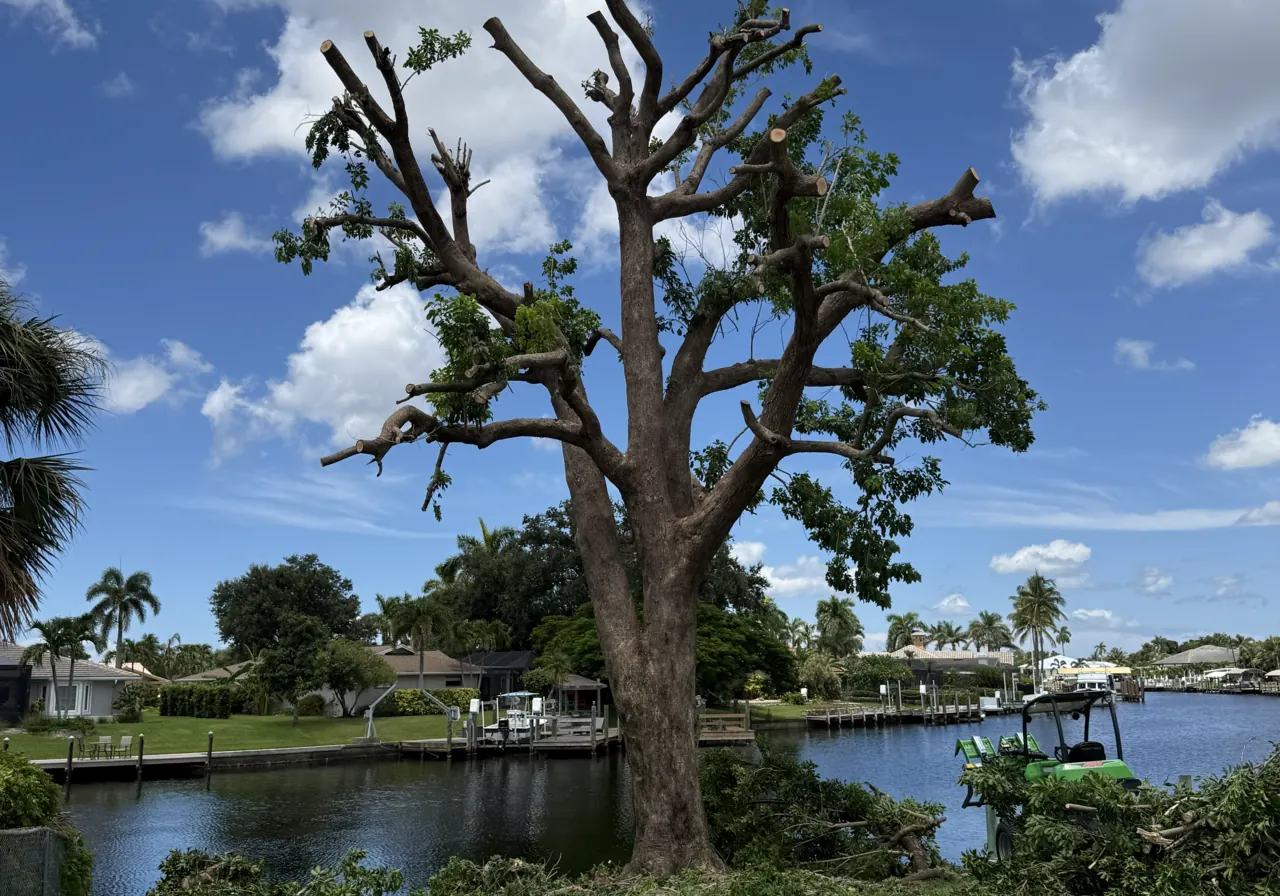
Tree Trimming & Pruning in Southwest Florida
Healthier, safer, better-looking trees
Davie Tree Service trims and prunes trees throughout Southwest Florida using proper cuts that follow the ANSI A300 standard and ISA best practice. We clean, thin, raise, and reduce canopies, deadwood hardwoods, prune palms correctly, and clear limbs off roofs, driveways, and service lines. We are licensed and insured, carry $1 million in liability coverage, have served the region since 1984, and give free written quotes.
What's Included
Good pruning is subtraction done with a plan: the right cuts in the right places to make a tree healthier, safer, and stronger against storms. Here is what is included when Davie Tree Service trims and prunes trees across Southwest Florida.
Crown cleaning and deadwooding
Removal of dead, dying, diseased, and broken branches from the canopy of oaks, black olives, mahoganies, and other hardwoods. Deadwood is the branch most likely to drop on a roof, car, or person. Clean cuts at the branch collar let the wound seal instead of tearing.
Crown thinning and reduction
Selective thinning that opens the canopy so wind and light pass through, plus crown reduction that shortens overextended limbs back to sound lateral branches. Both are done to ANSI A300 dose limits so the tree is never stripped or topped. This is the real hurricane preparation for hardwoods.
Crown raising and structure clearance
Raising the canopy for clearance over roofs, driveways, sidewalks, pool cages, and service lines, and structural pruning of young trees to build one strong central leader. We clear limbs off structures without lion-tailing the branch. Clearance work prevents rubbing damage and roof debris.
Palm pruning done correctly
Palm trimming that removes dead and hanging fronds, seed pods, and coconuts using a conservative 9-and-3 approach rather than the damaging hurricane cut. Over-pruning a palm weakens it, so we leave the green fronds a healthy palm needs. We service sabal, queen, coconut, and royal palms.
Signs your trees need trimming or pruning
Your trees need trimming when you can see dead branches over the roof, limbs touching the house or pool cage, storm-broken hangers lodged in the canopy, a canopy so dense it shades out the lawn, low limbs blocking the driveway, palm fronds or seed pods dropping, or previous topping growing back as weak, bushy sprouts. Any one of these is a reason to schedule an assessment. Several together usually mean the tree is overdue.
Some signs are safety hazards that should be handled soon, and others are maintenance that can be scheduled. Davie Tree Service can tell you which is which during a free assessment across Southwest Florida.
Dead branches or hangers over the roof
Dead branches and storm-broken hangers over your roof are the most urgent pruning need, because a dead limb can drop with no warning and a hanger is already under tension in the canopy. Deadwood and hangers should be removed before the next storm or strong sea breeze finishes the job. This is routine deadwooding for a trained crew and a serious hazard for a homeowner on a ladder.
Limbs touching the house, pool cage, or driveway
Limbs touching your house, pool cage, or lanai should be cleared because constant rubbing wears through shingles and screen, and any contact point becomes a bridge for rodents and ants. Low limbs over a driveway that scrape vehicles or block sight lines call for crown raising. Clearance pruning keeps the canopy off structures without gutting the tree.
Dense canopy shading out the lawn
A canopy so dense that grass will not grow beneath it is a sign the tree needs thinning, which lets filtered light and air reach the ground again. Live oaks and ficus in particular build heavy, layered canopies that block the lawn and catch wind like a sail. Proper crown thinning fixes both problems at once.
Dropping fronds, seed pods, or bad regrowth from topping
Falling palm fronds, hanging seed pods, and coconuts overhead mean a palm is due for pruning, and thick sprouting regrowth on a previously topped tree means it needs restoration. Topping regrowth is weakly attached and dangerous, and it gets worse each year it is ignored. Restoration pruning gradually rebuilds a sound structure from the mess a topping left behind.
Types of tree trimming and pruning we handle
Davie Tree Service handles every common pruning job in Southwest Florida: crown cleaning, crown thinning, crown raising and clearance, crown reduction, deadwooding, structural pruning of young trees, palm pruning and frond removal, coconut and seed pod removal, hurricane preparation thinning, clearance from structures and service lines, and restoration pruning of trees that were previously damaged or badly topped. Every cut follows the ANSI A300 pruning standard and ISA best practice, which is simply the way good, lasting tree work is done.
The single most important thing to understand about pruning is that more is not better. Topping and lion-tailing look like aggressive protection, but they damage the tree and create bigger hazards later. Correct pruning removes a modest, targeted amount and leaves a stronger tree.
Why topping and lion-tailing damage trees
Topping and lion-tailing are two harmful practices that weaken trees and create larger hazards over time, and Davie Tree Service does not do either. Topping cuts main limbs back to stubs, which starves the tree, triggers a burst of weakly attached water sprouts, and opens huge wounds to decay. Those sprouts grow back fast and are far more likely to snap in a storm than the original limbs were.
Lion-tailing strips all the inner and lower branches off a limb and leaves a tuft of foliage on the end, like a lion's tail. It looks tidy, but it moves all the weight to the tip, removes the growth that builds trunk strength, and exposes bark to sunscald. Proper thinning instead removes branches evenly throughout the canopy so weight and wind load stay balanced.
How to prune palms correctly (9-and-3, not the hurricane cut)
Correct palm pruning removes only dead, dying, and broken fronds plus seed pods and fruit, keeping the green fronds that sit at or above the horizontal, roughly a 9-and-3 clock face. The damaging hurricane cut strips a palm back to a few upright fronds, which starves it, invites disease into the bud, and leaves the trunk to narrow into a weak pencil point. Over-pruning a palm weakens it rather than protecting it.
Palms do not heal wounds the way hardwoods do, so every green frond removed is energy the palm cannot get back until it grows new ones. On sabal, queen, coconut, and royal palms we prune conservatively, remove seed pods and coconuts that could fall, and leave the healthy crown intact.
Hurricane preparation thinning and restoration pruning
Hurricane preparation thinning reduces a hardwood's wind resistance by opening the canopy so gusts pass through instead of pushing against a solid wall of leaves. Done to ANSI A300 limits, it removes weak, crossing, and deadwood limbs and leaves a balanced, wind-firm crown. It is the correct alternative to topping a tree before storm season.
Restoration pruning rehabilitates trees that were previously topped, storm-damaged, or badly cut. Over two or three visits we select the strongest sprouts, remove the rest, and gradually rebuild a sound branch structure. It takes patience, but it turns a hazard-prone tree back into a safe one.
| Practice | What it is | What it does to the tree |
|---|---|---|
| Proper thinning | Even removal of select branches throughout the canopy, within ANSI A300 limits | Lets wind and light through, keeps weight balanced, builds a stronger, storm-firm tree |
| Topping | Cutting main limbs back to stubs to shrink the tree | Starves the tree, opens decay, forces weak sprouts that snap more easily later |
| Lion-tailing | Stripping inner and lower branches, leaving foliage only at the tips | Moves weight to the ends, weakens limbs, causes sunscald, raises storm failure risk |
When to prune Southwest Florida trees and palms
The best time for heavy pruning in Southwest Florida is the dormant window from late winter into early spring, well ahead of the hurricane season that runs June 1 to November 30. Dead, broken, and hazardous limbs can be removed any time of year, but major structural thinning is best done before growth and storms ramp up. Heavy pruning during peak storm season is usually the wrong move.
Pruning heavily in August or September, at the height of the season, is a mistake for two reasons. It stresses the tree when it is already spending energy on new growth, and the fresh flush of tender sprouts it triggers is exactly the weak, wind-catching growth you do not want when a storm arrives. The real hurricane preparation is finished before June, not started in September.
How palms differ from hardwoods on timing
Palms differ from hardwoods because they can be pruned nearly year round, since you are removing spent fronds and seed pods rather than living structure. The main timing rule for palms is to remove seed pods and fruit before they mature and drop, and to avoid stripping green fronds at any time of year. Hardwoods like oak and mahogany, by contrast, have a clear dormant-season window for heavier work.
Common Southwest Florida species behavior
Live oak, laurel oak, black olive, and gumbo limbo each behave differently under the saw. Live oak is dense, wind-firm, and responds well to careful thinning, while faster-growing laurel oak needs more frequent deadwooding because it drops limbs and decays sooner. Black olive is a favorite shade tree over driveways but grows dense and needs regular raising and thinning to stay off vehicles and roofs.
Gumbo limbo, sometimes called the tourist tree for its peeling red bark, is remarkably resilient and recovers quickly from pruning and even storm breakage, which is one reason it is planted so widely along coastal Naples and Fort Myers. Slash pine, sabal palm, and coastal sea grape all have their own habits, and our crews prune each to what the species actually needs.
- Best heavy pruning window: late winter into early spring, before the June 1 to November 30 hurricane season.
- Year round: dead, broken, and hazardous limbs can be removed any time, on any species.
- Palms: prune nearly year round for dead fronds, seed pods, and coconuts, but never strip green fronds.
- Avoid: heavy structural pruning during peak storm season, which stresses the tree and forces weak new growth.
Our Process
- 1
Free assessment and pruning plan
Davie Tree Service starts with a free on-site assessment where we walk your property, identify each tree and palm, note deadwood, hazards, and clearance needs, and explain what each tree actually needs. We set clear pruning objectives, whether that is thinning for storm season, raising for driveway clearance, or restoring a topped tree, and give you a written quote before any cut is made.
- 2
Proper cuts to the ANSI A300 standard
Our crews climb or use bucket trucks to make precise cuts at the branch collar, following the ANSI A300 pruning standard and ISA best practice. We thin evenly, never top or lion-tail, respect dose limits so no more than the right amount of live canopy comes off, and prune palms conservatively. Every cut is placed to seal cleanly and keep the tree structurally sound.
- 3
Full cleanup and haul-away
When the pruning is done we chip every branch and frond, rake the area, and haul all the debris off your property, leaving your yard cleaner than we found it. Usable wood chips can be left as mulch on request. For recurring maintenance we can set a schedule so your trees stay healthy and storm-ready year after year.
What tree trimming costs and what drives the price
Tree trimming cost in Southwest Florida is driven by tree size and count, canopy density, the equipment needed to reach the work, debris volume, and how close the tree sits to structures and power lines. A single small palm costs far less than a large, dense live oak overhanging a pool cage that requires careful rigging and a bucket truck. There is no flat rate, which is why Davie Tree Service gives a free written quote after seeing the tree.
Access and proximity matter as much as size. A tree in an open backyard is quick to work, while the same tree over a screened lanai, a canal seawall in Cape Coral, or tangled near a service line takes more time, more rigging, and more care, which affects the price. Recurring maintenance usually costs less per visit than a one-off overhaul of a long-neglected tree.
The main price drivers, plainly
The biggest cost factors are size, count, and access, in that order. A tall, wide canopy takes longer and often needs a bucket truck or climber, several trees cost more than one, and anything over a roof, pool cage, or power line requires slow, controlled rigging. Dense canopies produce more debris to chip and haul, and debris volume is its own line of the job.
Recurring maintenance versus a one-off overhaul
Trees on a regular pruning schedule cost less per visit than a tree that has been left for a decade, because the crew removes a manageable amount each time instead of an overgrown, deadwood-filled canopy all at once. A neglected tree may also need restoration over multiple visits, which spreads the work out. Setting a maintenance schedule with Davie Tree Service keeps trees healthier and each visit more affordable.
| Factor | Costs less | Costs more |
|---|---|---|
| Tree size | Small palm or young tree | Large, tall, wide-canopy hardwood |
| Canopy density | Open, light canopy | Dense, layered, deadwood-filled canopy |
| Access and equipment | Open yard, ground or ladder work | Bucket truck or climber and rigging |
| Proximity | Away from structures and lines | Over roof, pool cage, or near service lines |
| Schedule | Recurring maintenance visit | One-off overhaul of a neglected tree |
Permits, HOAs, and local rules for tree trimming
Permit and approval requirements for tree work vary by city and county across Lee and Collier counties, and the rules change over time. Davie Tree Service can point you in the right direction and confirm what is needed before work begins. Routine pruning and palm trimming are often more straightforward than removals, but requirements differ from place to place and are worth checking rather than assuming.
Homeowners associations add their own layer. Many HOAs in Southwest Florida have guidelines about tree height, canopy clearance, palm appearance, and approved contractors, and some require insured, licensed crews on file. If your property is in an HOA community, check its rules and any approval steps before scheduling. We help you understand which situation you are in and recommend confirming current requirements with the local authority or your association before we start.
Why tree trimming is not a DIY job
Tree trimming is not a safe DIY job because it combines chainsaws, ladders, heights, and often power lines, which is how homeowners are seriously injured every year in Southwest Florida. A limb rarely falls where an untrained person expects, a chainsaw kicks back in an instant, and a ladder against a springy branch is a fall waiting to happen. Palms hide sharp spines and heavy, unpredictable frond bases.
Davie Tree Service crews are trained to rig and lower limbs safely, work aloft from bucket trucks and climbing lines, and prune to the ANSI A300 standard and ISA best practice. We are licensed and insured and carry $1 million in liability coverage, so the risk of the work stays on us, not on you.
- Limbs falling in the wrong direction onto people, roofs, screens, or vehicles.
- Chainsaw kickback and ladder falls, the leading causes of homeowner tree injuries.
- Branches contacting or hiding energized service lines, which can be fatal.
- Palm frond bases and spines that fall heavily and cut, and hidden decay in old wood.
Cleanup and what happens to the trimmings
After every trimming job, Davie Tree Service chips the branches, rakes up the leaves and small debris, and hauls all of it off your property, leaving the yard cleaner than we found it. We do not leave brush piled at the curb or fronds scattered across the lawn. Palm fronds, seed pods, and coconuts all go with us unless you ask to keep them.
Usable wood chips can be left as mulch for your beds if you want them, which puts the trimmings to work in your own landscape. When trimming turns into a removal, our crews and vetted local partners can grind the stump six to twelve inches below grade so the area is ready to replant. We finish the job so your only takeaway is a healthier, safer set of trees.
Related Tree Services
- Tree Removal takes over when a tree is beyond saving from decay, storm damage, or a bad past topping, removing it safely with full cleanup.
- Storm Damage & Emergency Tree Service responds 24/7 when limbs break or trees fail in a storm, clearing broken hangers and fallen wood before it does more damage.
- Stump Grinding & Removal handles the stump after a trimming turns into a removal, grinding it six to twelve inches below grade so you can replant.
- Land Clearing & Lot Clearing tackles overgrown lots and heavy brush when the job is bigger than pruning, clearing vegetation across larger properties and acreage.
Tree Trimming & Pruning FAQs
How often should trees be trimmed in Southwest Florida?
When is the best time to prune trees here?
Does proper pruning really help trees survive hurricanes?
What is tree topping and why do you refuse to do it?
What is lion-tailing and is it bad for my tree?
How should palm trees be trimmed correctly?
Can you clear branches off my roof, driveway, or pool cage?
Which cutting standard do you follow when pruning?
Can a tree that was topped in the past be fixed?
How much does tree trimming cost?
Do you handle both hardwoods and palms?
Do you clean up all the branches and fronds?
Do I need a permit or HOA approval to trim my trees?
Proudly Serving Southwest Florida
Local, dependable tree service across Lee and Collier counties. Tap your city to learn more.
Davie Tree Service provides tree trimming and pruning across Southwest Florida, including Fort Myers, Cape Coral, Naples, Bonita Springs, Estero, and Lehigh Acres, throughout Lee and Collier counties. From the older, heavy canopy in Fort Myers to canal lots in Cape Coral, coastal plantings in Naples, and wide vacant lots in Lehigh Acres, our licensed and insured crews prune to the proper standard for each species and site. Call 239-693-5042 for a free written quote, and see how we serve your specific area below.