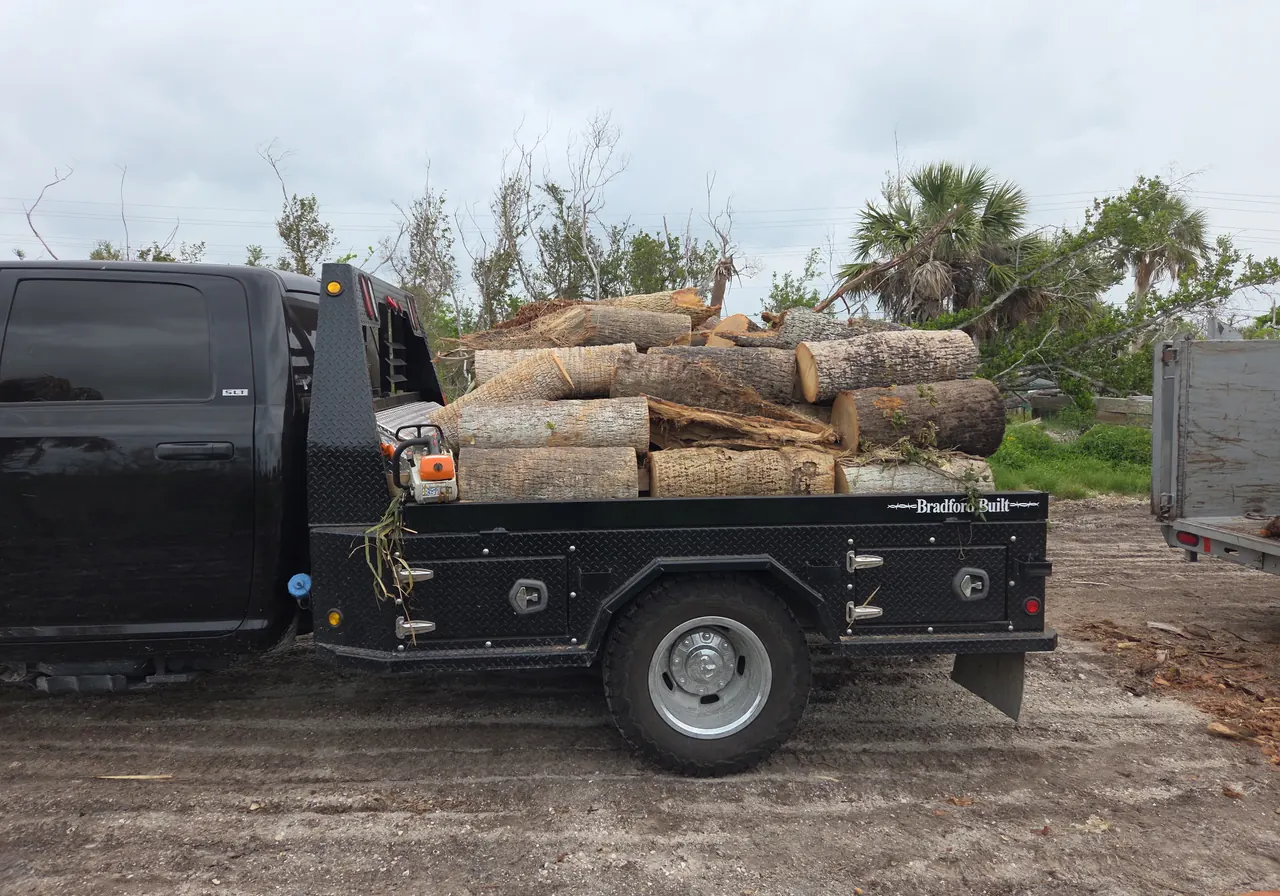
Tree Removal in Southwest Florida
Safe, complete removal of trees of any size
Davie Tree Service provides safe, complete tree removal throughout Southwest Florida. Our licensed and insured crews take down large oaks, palms, dead trees, hazardous leaners, and storm-damaged trees of any size, using rigging, bucket trucks, and crane assistance when access is tight. We clean up fully and can grind the stump on request. We have served the region since 1984 and carry $1 million in liability coverage on every job.
What's Included
Every tree removal from Davie Tree Service is planned around safety, protecting your home and landscaping, and leaving the site clean. Here is what is included when we take a tree down anywhere in Southwest Florida.
Large, dead, and hazardous tree removal
Safe takedown of oversized, dead, diseased, and dangerously leaning trees, from mature live oaks to declining laurel oaks and slash pines. We use bucket trucks, climbers, and crane assistance when the size or location calls for it. Available across Lee and Collier counties.
Technical and sectional dismantling
Rigging and piece-by-piece dismantling for trees that cannot simply be felled, such as removals over a pool cage, beside a lanai, or between houses on a canal lot. We lower each section under control rather than dropping weight. This protects roofs, screens, and seawalls.
Palm and invasive species removal
Removal of queen palms, coconut palms, royal palms, and overgrown sabal palms, plus invasive Australian pine, melaleuca, and Brazilian pepper. Palms are handled differently than hardwoods because of their heavy fibrous trunks. We haul the heavy trunk sections completely off your property.
Full cleanup and optional stump grinding
Every removal ends with limbs chipped, logs sectioned, and all debris hauled away, leaving your property tidy. Add stump grinding and our crews and vetted local partners grind the stump six to twelve inches below grade. The area is then ready to replant, sod, or pave.
Signs a tree needs to be removed
A tree usually needs removal when it leans more than it used to, heaves the soil at its base, grows mushrooms or conks on the trunk, sounds hollow, or drops large deadwood over a structure. These are the clearest warning signs that a tree has become a hazard. In Southwest Florida, a recent change is more telling than a long-standing condition, because saturated soil and storm loading make failures sudden.
Davie Tree Service can assess any of these symptoms before the season and give you an honest recommendation. Not every flawed tree needs to come down, but the signs below are the ones worth a professional look on your Southwest Florida property.
- Leaning that changed recently: a lean that appeared or worsened after heavy rain or wind often means the root plate is already failing and the tree can go the rest of the way.
- Soil heaving or lifting at the root plate: cracked or mounded soil on one side of the trunk shows the roots are pulling loose from the ground.
- Mushrooms or conks at the base: shelf fungi and mushrooms on the trunk or root flare are signs of internal wood decay that hollows the tree from within.
- Hollow or soft trunk: a trunk that sounds hollow when tapped, shows soft punky wood, or has open cavities has lost the structural strength that keeps it standing.
- Large deadwood over a structure: dead limbs the size of your arm or larger hanging above a roof, driveway, or lanai will eventually drop, and they drop without warning.
- Cracks in a main union: a split or crack where two large stems meet is a weak point that tends to fail under wind or the tree's own weight.
- Canopy dieback: whole sections of the crown thinning, browning, or dropping leaves out of season signal decline the tree may not recover from.
- Roots damaging a driveway, seawall, or pool deck: ficus, banyan, and mature oak roots that lift concrete or crack a seawall are a structural problem removal often solves.
- Storm damage beyond repair: split trunks, torn crowns, and uprooted trees after a hurricane are frequently past saving and are safer removed.
- Planted too close to structures: a large-growing species set a few feet from the house, pool cage, or foundation eventually outgrows the space and threatens what is next to it.
Types of tree removal we handle
Davie Tree Service handles every kind of tree removal common in Southwest Florida: hazardous and dead trees, large oaks, palms, emergency takedowns, technical dismantling in tight spaces, crane-assisted removals, removals close to a house or pool cage, removals near power lines, canal and waterfront lots, jobs with limited gate access, lightning-struck trees, storm-damaged and uprooted trees, and invasive species. Each scenario calls for a different method, and our crews match the technique to the tree and its surroundings.
Hazardous, dead, and lightning-struck tree removal
Hazardous, dead, and lightning-struck trees are removed before they fail on their own, because a dead or damaged tree loses wood strength and becomes unpredictable. A lightning strike often splits the trunk or kills the tree even when the outside looks intact. We assess whether the tree can be climbed safely or must be dismantled with a bucket truck or crane, then take it down in controlled sections.
Large oak removal
Large oak removal, whether a wind-firm live oak or a declining laurel oak, is a heavy, high-skill job that we handle with rigging, bucket trucks, and crane assistance when needed. Mature oaks carry wide, heavy canopies that cannot simply be dropped in a Southwest Florida yard. We rig and lower the major limbs and trunk sections so nothing swings into the house, driveway, or neighboring property.
Palm removal
Palm removal covers queen palms, coconut palms, royal palms, sabal (cabbage) palms, and others, and it is worked differently than a hardwood. Palms have no spreading crown to rig, but their fibrous trunks are dense and heavy, so much of the work is safe sectioning and hauling the weight. We cut the trunk into manageable pieces and remove it completely rather than leaving heavy logs behind.
Technical and sectional dismantling in tight spaces
Technical and sectional dismantling is used when a tree cannot be felled in one piece, such as between two houses, over a screened lanai, or beside a seawall. Our climbers and crews take the tree apart from the top down, rigging each limb and trunk section to a controlled lower. This is the standard approach for the tight lots and close structures common across the region.
Crane-assisted removal
Crane-assisted removal is used for very large trees, trees with no ground access for equipment, and removals where lifting sections straight up and out is safer than lowering them by rope. A crane picks each cut piece and swings it clear of the roof, pool cage, or lanai to a drop zone. This shortens the job and reduces the load carried over your structures.
Removals close to a house, pool cage, or lanai
Removals close to a house, pool cage, or screened lanai are handled with careful rigging so no section is allowed to swing or drop onto what it must protect. Pool cages and lanais are common in Cape Coral, Estero, and Naples and are expensive to replace. We lower each piece to a clear landing area rather than dragging weight across the enclosure.
Removals near power lines
Removals near power lines start with identifying who owns the line and whether the utility must de-energize it before work is safe. Energized service and primary lines are the utility's responsibility, and tree work near them requires the right clearances and precautions. We plan the takedown so no limb or section falls toward the line, and we coordinate with the provider when contact is a risk.
Canal, waterfront, and limited-access lot removals
Canal and waterfront lot removals, and lots with limited or no gate access, are handled by matching the method to what can physically reach the tree. On a Cape Coral canal lot the crane or crew may work from the street side while protecting the seawall and dock. Where a gate is too narrow for equipment, we climb, rig, and carry sections out by hand.
Storm-damaged, uprooted, and invasive tree removal
Storm-damaged and uprooted trees are removed by first relieving the stored tension in bent trunks and lodged limbs, then taking the tree down in controlled pieces. Uprooted trees after saturated wet-season soil are live hazards even when they look stable. We also remove invasive Australian pine, melaleuca, and Brazilian pepper, which spread aggressively and are poor performers in wind.
| Method | When it is used | Typical situations |
|---|---|---|
| Straight felling | Open space with a clear drop zone all around the tree | Vacant lots in Lehigh Acres, acreage, and pastures with room to fall |
| Sectional dismantling | Tight lots and close structures with no safe drop zone | Trees between houses, over a lanai, or beside a seawall or pool cage |
| Crane-assisted removal | Very large trees, poor equipment access, or heavy loads over structures | Large oaks over a roof, canal lots, and trees a bucket truck cannot reach |
Southwest Florida trees and conditions that affect removal
Southwest Florida species and soil conditions strongly shape when and how a tree should be removed. Live oak and laurel oak behave very differently in wind, palms are priced and worked unlike hardwoods, ficus and banyan roots threaten foundations and pipes, and saturated wet-season soil fails root plates in only moderate wind. Knowing your species is the first step in an honest removal decision.
Why live oak and laurel oak behave differently in wind
Live oak is dense, wind-firm, and long-lived, while laurel oak grows faster, has weaker wood, and is prone to internal decay and limb drop. A well-pruned live oak can stand for well over a century, but laurel oaks often begin to decline around 40 to 60 years and become hazards much earlier. Many mature laurel oaks in older Fort Myers neighborhoods are past their reliable life and worth a hazard assessment.
Why palm removal is priced differently than hardwood
Palm removal is priced differently because a palm has no spreading crown to rig, but it carries a heavy, fibrous, water-laden trunk. With a hardwood, much of the labor is rigging and lowering wide limbs; with a palm, the labor is sectioning the trunk and hauling its dense weight. A small queen palm off a fence line costs far less than a large oak leaning over a pool cage.
Ficus and banyan roots near foundations, pools, and pipes
Ficus and banyan trees develop aggressive, far-reaching root systems that lift driveways, crack pool decks and seawalls, and invade pipes. Planted decades ago as shade and privacy trees, they routinely outgrow residential lots. When roots begin damaging structures, removal is often the only lasting fix, and the root system itself becomes part of the job.
Invasive species and saturated-soil root failure
Australian pine and melaleuca are invasive across Southwest Florida, grow tall and shallow-rooted, and fail readily in storms, which makes their removal both an ecological and a safety improvement. Brazilian pepper spreads as dense invasive brush. On top of species, the wet season saturates the region's sandy soil, and a soaked root plate can let even a healthy tree lean or uproot in moderate wind.
Our Process
- 1
Free on-site assessment and written quote
Davie Tree Service starts with a free on-site look at the tree, the surrounding structures, and the access for equipment. We identify the species, judge its condition, and decide whether it can be climbed, needs a bucket truck, or calls for crane assistance. Then we give you a clear written quote before any work begins, so there are no surprises.
- 2
Safe, planned removal
Our crews take the tree down with the method that fits the site: straight felling where there is room, sectional dismantling in tight spaces, or crane assistance for heavy loads over structures. We rig and lower each limb and trunk section under control to protect your roof, pool cage, seawall, and landscaping. Removals follow ANSI A300 standards and ISA best practices for safe work.
- 3
Cleanup, haul-away, and optional stump grinding
We chip the limbs, section the trunk, and haul all debris off your property, leaving the site tidy rather than cleared to the curb. Wood chips can stay as mulch or logs can be sectioned for firewood on request. Add stump grinding and our crews and vetted local partners grind the stump six to twelve inches below grade so the area is ready to replant or pave.
What tree removal costs and what drives the price
Tree removal cost is driven mostly by the tree's height and trunk diameter, its species and wood density, how close it stands to structures, and how easily equipment can reach it. A small palm in an open yard is one of the least expensive jobs, while a large, dense oak leaning over a screened pool cage on a tight canal lot is one of the most involved. Access, crane requirements, and debris volume move the price as much as raw size does.
Davie Tree Service gives every homeowner a free written quote up front, so you know the full scope before any work begins. Rather than quote figures blind, we look at the specific tree and site, because two oaks of the same height can price very differently depending on what surrounds them.
The main factors that raise or lower the price
The biggest cost factors are size, species and wood density, proximity to structures, equipment access, whether a crane is required, and total debris volume. A dense hardwood like live oak weighs far more per foot than a palm or a slash pine, which affects the rigging and hauling. Whether stump grinding is included, and whether the call is an emergency or a scheduled visit, also shape the final price.
Why access and location matter so much here
Access and location often matter more than the tree itself in Southwest Florida. A tree a truck can pull right up to is straightforward, while the same tree behind a narrow gate, over a lanai, or on a canal lot may need hand-carrying or a crane. Removals close to a house, pool cage, seawall, or power line take more time and rigging to do safely, which is reflected in the quote.
| Factor | Lower cost | Higher cost |
|---|---|---|
| Size | Small tree, thin trunk | Tall tree, large-diameter trunk |
| Species and wood density | Palm or light-wooded pine | Dense live oak or mature ficus |
| Proximity to structures | Open yard, clear drop zone | Over a pool cage, house, or seawall |
| Equipment access | Truck can reach the tree | Narrow gate, canal lot, or crane needed |
| Debris and extras | Low volume, no stump | High volume, stump grinding, emergency call |
Permits, HOAs, and local rules for tree removal
Permit requirements for tree removal vary by city and county across Lee and Collier counties, and the rules change over time. Davie Tree Service can point you in the right direction and confirm what is needed before work begins. Some removals need no approval, while others may require a review depending on the tree, its size, and the property, so it is worth checking rather than assuming.
Homeowners associations and deed-restricted communities often have their own guidelines on removals and replacements that apply in addition to any city or county rules. If your property sits in an HOA, confirm its process alongside the local requirements. For a genuine emergency, such as a tree on your home or blocking your only exit, making the property safe generally proceeds without delay, and we help you understand which situation you are in.
Why tree removal is not a DIY job
Tree removal is not a DIY job because large trees carry stored energy, unpredictable weight, and hidden decay, which is how homeowners are seriously injured every year attempting their own takedowns. A partly cut trunk can barber-chair and split upward, a rigged limb can swing into a wall, and a chainsaw in a leaning tree can kick back violently. Add power lines, ladders, and Southwest Florida heat and the risk multiplies fast.
Davie Tree Service crews are trained to rig and lower heavy sections under control and follow ANSI A300 standards and ISA best practices. We are licensed and insured and carry $1 million in liability coverage, so the risk of the work stays on us, not on you or your property.
- Falling and swinging sections can crush roofs, pool cages, vehicles, and people below.
- Leaning and partly cut trunks store spring energy that releases without warning.
- Power lines near the canopy can energize ladders, metal, and standing water.
- Hidden internal decay makes a trunk fail in a direction no one expected.
Cleanup and what happens to the debris
After a removal, Davie Tree Service chips the limbs, cuts the trunk into manageable sections, and hauls all the debris off your property, leaving the site clean and ready to use. We do not simply drag material to the curb and leave it. For large trees and high debris volume, our crews and vetted local partners load and remove the piles completely.
Usable wood chips can stay on site as mulch if you want them, and larger logs can be sectioned for firewood on request. When you add stump grinding, our crews and vetted local partners grind the stump and surface roots six to twelve inches below grade so the area is ready to level, replant, sod, or pave.
Related Tree Services
- Stump Grinding & Removal handles the stump after your tree comes down, grinding it and the surface roots six to twelve inches below grade so the area is ready to replant or pave.
- Tree Trimming & Pruning is often the better choice when a tree can be saved instead of removed, correcting structure and clearing deadwood so a healthy tree stays standing.
- Storm Damage & Emergency Tree Service steps in when a removal cannot wait, with 24/7 response for trees on homes, hazardous leaners, and uprooted trees after a storm.
- Land Clearing & Lot Clearing takes on multiple trees and brush across a whole lot, clearing overgrown or wooded property when a single removal is not enough.
Tree Removal FAQs
How much does tree removal cost in Southwest Florida?
Do you remove large oaks and trees close to my house?
How do I know if my tree needs to be removed?
Why are palms priced differently than hardwood trees?
Do laurel oaks really fail sooner than live oaks?
Can you remove a tree in a tight space between houses?
Do you use a crane for tree removal?
Do you remove invasive trees like Australian pine and melaleuca?
Will you clean up all the debris after removal?
What happens to the stump after the tree is removed?
Should I remove a tree or can trimming save it?
Do I need a permit to remove a tree in Lee or Collier County?
Are you licensed and insured for tree removal?
How fast can you remove a hazardous or storm-damaged tree?
Proudly Serving Southwest Florida
Local, dependable tree service across Lee and Collier counties. Tap your city to learn more.
Davie Tree Service provides tree removal across Southwest Florida, including Fort Myers, Cape Coral, Naples, Bonita Springs, Estero, and Lehigh Acres, throughout Lee and Collier counties. From the older canopy in Fort Myers to canal lots in Cape Coral, vacant lots in Lehigh Acres, and coastal properties in Naples, our licensed and insured crews take down trees of any size and clean up completely. Call 239-693-5042 for a free written quote, and see how we serve your specific area below.