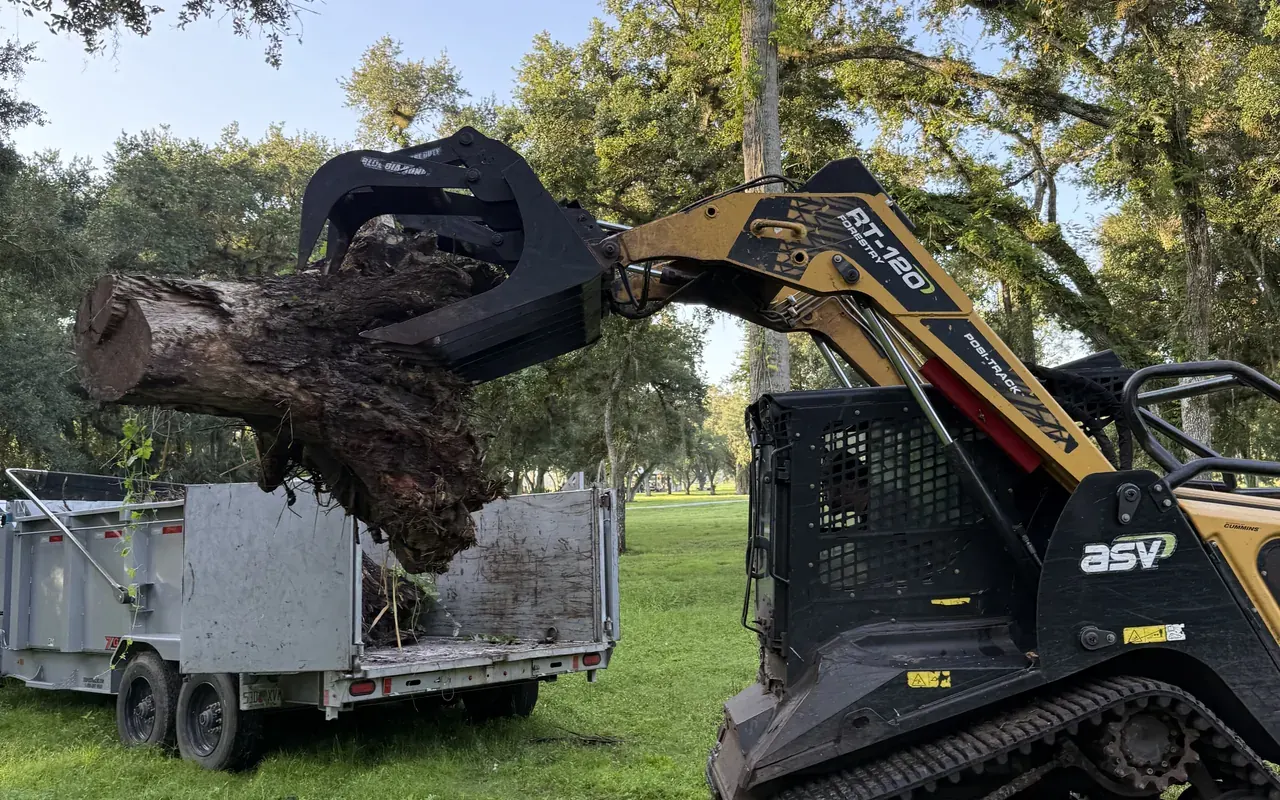
Stump Grinding & Removal in Southwest Florida
Grind stumps below grade and reclaim your yard
Davie Tree Service grinds and removes tree and palm stumps throughout Southwest Florida. We grind six to twelve inches below grade, deeper where you plan to replant or lay hardscape, then rake out or haul the grindings and can backfill the hole. We are licensed and insured, carry $1 million in liability coverage, have served the region since 1984, and locate utilities, irrigation, and pet fence lines before any grinder touches the ground.
What's Included
Every stump job from Davie Tree Service starts with locating what is underground, then grinds the stump well below grade, then leaves the area ready to replant or pave. Here is what is included when we grind or excavate a stump anywhere in Southwest Florida.
Below-grade stump grinding
We grind stumps six to twelve inches below grade so the wood is gone, not just cut flush. We grind deeper where you plan to replant a tree, lay sod, or pour a slab or paver base. This eliminates trip hazards and the pests that gather in a decaying stump.
Surface and buttress root grinding
We grind the protruding surface roots and buttress flares that crack sidewalks, lift lawns, and dull mower blades. Many hardwoods in Southwest Florida send roots along the surface in our shallow sandy soil. Grinding those flares smooths the area so it can be sodded or paved.
Palm, hardwood, and multiple stumps
We grind fibrous sabal and queen palm stumps, dense live oak and mahogany hardwood stumps, and clusters of stumps left across a cleared lot. Palm stumps grind differently than hardwoods because they have no true growth rings. Our equipment and vetted local partners handle any size or count.
Grindings removal and backfill
We rake the grindings back into the hole as fill, or haul them away and backfill with clean soil if you are planting or paving. You choose based on your plans for the spot. Either way the area is left level, tidy, and ready for the next step.
Signs you should grind a stump, and what to expect
Grind a stump when it is a trip hazard in the yard, when it damages your mower, when it sprouts new growth, when it attracts termites, ants, or fungus, or when you want the space back for sod, a garden bed, or hardscape. A leftover stump is a slow problem: it decays for years, feeds pests, and can send up suckers. Grinding six to twelve inches below grade ends all of that at once.
Davie Tree Service grinds stumps throughout Southwest Florida, and homeowners most often ask what happens to the grindings, whether the hole is filled, how soon they can plant, and whether roots keep sprouting. The answers below are the ones people search for most.
What happens to the grindings after you grind a stump?
The grindings become a pile of shredded wood and soil mixed together, and you decide where they go. We can rake them back into the hole as fill, spread them as a coarse mulch in beds away from the trunk, or haul them off your property entirely.
Fresh grindings settle over a few weeks as they compact and break down, so a mound left as fill will sink to grade over time. If you want the spot ready for sod or planting right away, we haul the grindings and backfill with clean soil instead.
Is the hole backfilled after stump grinding?
Yes, we can backfill the hole either way you prefer. The default is to rake the grindings back in and mound them slightly to allow for settling. If you plan to plant grass, a shrub, or a new tree, we haul the grindings and backfill with clean topsoil so the roots have real soil, not wood chips, to grow into.
Can I plant or lay sod in the same spot, and how soon?
Yes, you can plant or sod the same spot once the grindings are removed and the hole is backfilled with clean soil, usually right after the job for sod and small plants. Grindings left as fill are too woody and nitrogen-hungry for new grass or plants, so replace them with topsoil first.
For a replacement tree, plant a foot or two to the side of the old stump if you can, since leftover roots and grindings in the exact center make a poor rooting zone. Tell us your plans and we grind deeper and haul the grindings so the area is ready.
Do roots keep sprouting after the stump is ground?
Most trees do not resprout once the stump is ground below grade, but a few aggressive species do send up suckers from roots left in the ground. Ficus and Brazilian pepper are the worst offenders in Southwest Florida, and both can push new shoots from surface roots for months after grinding.
For those species we grind wider to catch more of the root flare, and we tell you what to expect: any suckers that appear are easy to cut or spot-treat as they show up, and they weaken and stop as the roots exhaust their stored energy.
What happens to the roots left in the ground?
Roots left in the ground after grinding decay naturally in place over the following years, which is normal and expected. Grinding removes the stump and the major buttress flares, not the entire root system, because chasing every root would tear up your whole yard. In Southwest Florida's warm, sandy soil, roots break down steadily and enrich the soil as they go.
How are utilities, irrigation, and pet fence lines located first?
Before any grinding starts, we call in a utility locate for buried public lines and visually trace the private lines a locate does not cover: irrigation heads and pipe, low-voltage landscape lighting, and invisible pet fence wire. Grinder teeth cut several inches into the soil, so hitting a line is a real risk we plan around.
You know your yard best, so we ask where sprinkler lines run and where the pet fence loop was installed. We grind carefully around marked lines, and our crews and vetted local partners reroute or flag anything that sits directly under the stump.
Types of stump grinding and removal we handle
Davie Tree Service handles every stump situation common in Southwest Florida: standard below-grade grinding, surface and buttress root grinding, large hardwood stumps, fibrous palm stumps, multiple and cluster stumps across a lot, tight-access backyard stumps behind narrow gates, and full stump excavation where grinding is not enough. Each type needs a different machine, depth, and approach, and we match the method to the stump and to your plans for the space.
Below-grade grinding and how deep we go
Standard grinding takes the stump six to twelve inches below grade, which is enough to remove the trip hazard and let you sod or landscape over it. We grind deeper, often eighteen inches or more, when you plan to replant a tree in the same area or set a hardscape base like pavers or a slab. Tell us the plan and we set the depth to match.
Surface and buttress root grinding
Surface root grinding removes the roots and buttress flares that snake across the ground away from the trunk, cracking walkways and scalping under the mower. Live oak, laurel oak, ficus, and black olive are notorious for surface roots in our shallow sandy soil. We grind the visible flares down smooth so the area levels out for sod or paving.
Large hardwood stumps
Large hardwood stumps from live oak, laurel oak, mahogany, black olive, and mature ficus are dense, wide, and slow to grind, and they call for a bigger machine and more time. A wide oak stump can measure several feet across at the base with heavy buttress roots. We grind the whole crown and the major flares, not just the center.
Palm stumps and why they grind differently
Palm stumps grind differently than hardwoods because palms are not woody trees: they have fibrous, stringy trunks, no true growth rings, and a dense root ball of many thin roots rather than a few thick ones. Sabal (cabbage) palms, queen palms, coconut palms, and royal palms leave a wet, fibrous stump that shreds rather than chips.
Palm stumps also decompose faster and differently than hardwood, and their root balls are compact, so grinding is often quicker than an oak of the same width. We grind palm stumps below grade so no fibrous mass is left to hold moisture and pests.
Multiple and cluster stumps
Multiple or cluster stumps, such as a row of removed palms, a stand of melaleuca or Brazilian pepper, or every stump left after a lot is cleared, are ground in one mobilization so you pay for one trip, not many. We map the stumps, locate lines across the whole area, and grind them in sequence, which is far more efficient than one-off visits.
Tight-access and backyard stumps
Tight-access stumps behind narrow gates, in fenced backyards, or between a house and a seawall call for a compact grinder that fits through a standard thirty-six-inch gate. Southwest Florida backyards are often boxed in by fences, pool cages, and canal seawalls. We bring a machine sized to the opening rather than declining the job or removing a fence panel.
Grinding versus full stump excavation
Grinding shreds the stump in place and leaves the deeper roots to decay, while full excavation digs the entire stump and root ball out of the ground. Grinding is faster, cleaner, cheaper, and right for most yards. Excavation is for when the ground must be truly clear, such as before a foundation, pool, or utility trench, and it is heavier work performed by our crews and vetted local partners.
| Factor | Stump grinding | Full excavation |
|---|---|---|
| Depth | Six to twelve inches below grade, deeper on request | Entire stump and root ball dug out |
| Site disruption | Minimal, contained to the stump area | Heavy, tears up surrounding soil |
| Cost relation | Lower cost for most jobs | Higher cost, more equipment and labor |
| Cleanup | Grindings raked in or hauled, hole backfilled | Large hole and spoil to remove and fill |
| Best for | Replanting, sod, landscaping, reclaiming space | Foundations, pools, trenches, fully clear soil |
Southwest Florida soils, species, and stump grinding
Southwest Florida's sandy, fast-draining soil makes grinding cleaner and backfill simpler than clay regions, but it also means trees run roots along the surface and certain species resprout aggressively after removal. Sandy soil grinds easily and settles predictably, while the region's warm, wet climate speeds both root decay and unwanted suckering. Species behavior and canal-lot conditions shape how we approach each stump.
Sandy soil, grinding, and backfill
Sandy Southwest Florida soil grinds fast and mixes evenly with the grindings, so backfill is straightforward and the ground settles cleanly to grade. The tradeoff is that shallow sandy soil pushes surface roots outward, so hardwoods like live oak and ficus leave wide flares to grind. Loose backfill also settles more than expected, so we mound grindings to allow for it.
Ficus and Brazilian pepper suckering after removal
Ficus and Brazilian pepper are the two species most likely to sprout suckers from roots left after grinding, and both are common here. Ficus roots run far and shallow and can push shoots yards from the old trunk. Brazilian pepper, an invasive, resprouts readily. We grind their flares wider and tell you how to knock back any suckers that appear.
Why palm stumps decompose differently
Palm stumps decompose differently than hardwood stumps because palm tissue is fibrous and moisture-holding rather than dense woody rings. A left palm stump stays wet, spongy, and pest-friendly longer than a hardwood stump of the same size. Grinding sabal, queen, coconut, and royal palm stumps below grade removes that wet fibrous mass so it cannot linger in the yard.
Grinding near seawalls, pool decks, and irrigation on canal lots
Grinding near a seawall, pool deck, or irrigation on a canal lot calls for extra care because the machine's teeth and vibration sit close to hardscape and buried lines. Cape Coral and coastal Naples canal lots pack a lot into a small footprint. We locate irrigation and lighting first, keep the grinder off the seawall cap, and grind so the deck and wall stay untouched.
Our Process
- 1
Free assessment and line location
Davie Tree Service looks at the stump's size, species, height above grade, and access, then plans how deep to grind based on whether you will replant, sod, or pave. We call in a utility locate for buried public lines and trace the private ones a locate does not cover: irrigation, landscape lighting, and invisible pet fence wire. You get a clear written quote before any work begins.
- 2
Below-grade grinding
We bring the right machine for the job, from a compact grinder that fits a thirty-six-inch gate to a larger unit for wide hardwood stumps, and grind six to twelve inches below grade, deeper for replanting or hardscape. We grind the crown and the major buttress and surface roots, not just the flush cut, so nothing is left to trip over or resprout.
- 3
Backfill, cleanup, and grade-ready finish
We rake the grindings back in as fill and mound them for settling, or haul them off and backfill with clean soil if you are planting or paving. We clean the surrounding area, leave the spot level, and tell you what to expect from any leftover roots. For full excavation, our crews and vetted local partners remove the stump, root ball, and spoil.
What stump grinding costs in Southwest Florida, and what drives it
Stump grinding is priced by the size and difficulty of the stump, not a flat fee, and the biggest drivers are diameter, wood hardness, height above grade, the number of stumps, grinder access, root spread, and whether you want the grindings hauled away. A small palm stump in an open front yard costs far less than a wide live oak stump with heavy buttress roots behind a narrow gate. Grinding several stumps in one visit lowers the per-stump cost.
Davie Tree Service gives a free written quote before any grinding begins, so you know the price up front. Full stump excavation costs more than grinding because it is heavier work with more equipment and a larger hole to fill, performed by our crews and vetted local partners when the ground must be fully clear.
What drives the price of stump grinding?
Diameter is the single largest driver, because grinding time climbs with stump width, and wood hardness matters just as much: a dense live oak or mahogany stump grinds far slower than a fibrous palm of the same size. Height above grade adds material to remove, and a wide root spread means more surface and buttress roots to chase.
Access and the number of stumps round it out. A stump a large grinder can reach is quicker and cheaper than one behind a narrow gate needing a compact machine, and clustered stumps ground in one trip cost less each than scattered single visits.
Grinding versus excavation on cost
Grinding costs less than excavation for the same stump because it uses one machine, disturbs little soil, and leaves a small hole. Excavation costs more: it needs digging equipment, hauls out the whole stump and root ball, and leaves a large hole to backfill. Choose grinding for a yard you will replant or landscape, and excavation only when the soil must be completely clear.
| Cost driver | Lower cost | Higher cost |
|---|---|---|
| Stump diameter | Small palm or sapling stump | Wide oak or ficus stump |
| Wood hardness | Fibrous palm, soft wood | Dense live oak, mahogany |
| Access | Open yard, large grinder fits | Narrow gate, compact grinder only |
| Number of stumps | Several ground in one trip | Single scattered visits |
| Grindings | Raked back in as fill | Hauled away, backfilled with soil |
Permits and rules for stump grinding in Southwest Florida
Permit requirements vary by city and county across Lee and Collier counties, and rules change over time, so Davie Tree Service can point you in the right direction and confirm what is needed before work begins. Grinding a stump from a tree already removed is usually the simplest part of the process, but if a stump sits in a right-of-way, an easement, or near protected or preserve areas, local rules and HOA guidelines may apply.
Utility line location is handled before grinding, not through a permit but through a proper locate for buried public lines plus a visual trace of private irrigation, lighting, and pet fence lines. If your HOA has requirements about site restoration or replanting after a removal, we work within them. When you are unsure what applies, we recommend confirming current requirements with your local authority before we grind.
Why stump grinding is not a DIY job
Stump grinding is not a DIY job because the machine throws wood and rock at high speed, the teeth cut through buried lines that a homeowner rarely knows how to locate, and a rented grinder is heavy, powerful, and easy to lose control of on uneven ground. Struck irrigation, electrical, or pet fence lines cause costly damage, and flying debris injures bystanders and cracks windows and cars nearby.
Davie Tree Service crews locate lines first, set up guards and clear the throw zone, and grind following ANSI A300 standards and ISA best practice for the work. We are licensed and insured and carry $1 million in liability coverage, so if a hidden line or hardscape is damaged the risk is on us, not on you.
- Grinders throw wood chips and rocks fast enough to injure people and crack glass.
- Teeth cut several inches into soil, striking buried irrigation, wiring, and pet fence lines.
- Rented grinders are heavy and unstable on slopes, near seawalls, and on soft ground.
- Unlocated utilities under a stump turn a quick job into a dangerous, expensive one.
Cleanup and what happens to the grindings
After grinding, Davie Tree Service leaves the area clean and level, with the grindings either raked back into the hole as fill or hauled off your property, whichever you choose. We do not leave a mound of shredded wood and torn-up ground for you to deal with. If you are planting or paving, we haul the grindings and backfill with clean soil so the spot is truly ready.
Grindings left as fill settle over a few weeks, so we mound them slightly to allow for it. Excess grindings can be spread as a coarse mulch in beds if you want them. For full excavation, our crews and vetted local partners remove the stump and root ball and haul away the spoil, then backfill the larger hole.
Related Tree Services
- Tree Removal comes first when a tree is still standing: we remove the tree, then grind the stump six to twelve inches below grade so nothing is left behind.
- Land Clearing & Lot Clearing is the answer when a whole lot is full of stumps, clearing and grinding many stumps and roots across acreage in one coordinated job.
- Tree Trimming & Pruning keeps the trees you are keeping healthy and structurally sound, with proper pruning that reduces the deadwood and hazards that lead to removals.
- Storm Damage & Emergency Tree Service handles the uprooted trees and exposed root plates a hurricane leaves behind, which we can then grind level so the area is ready to restore.
Stump Grinding & Removal FAQs
How deep do you grind stumps in Southwest Florida?
What is the difference between stump grinding and stump removal?
What happens to the wood grindings after you grind a stump?
Can I plant grass or a new tree where the stump was?
Will the stump grow back after grinding?
Do palm stumps grind differently than hardwood stumps?
How do you locate irrigation and pet fence lines before grinding?
Can you grind a stump in a tight or fenced backyard?
What happens to the roots left in the ground?
What drives the cost of stump grinding?
Do you grind the surface roots too, not just the stump?
Can you grind multiple stumps or a whole cleared lot?
Do I need a permit to grind a stump?
Is it safe to rent a grinder and do it myself?
Proudly Serving Southwest Florida
Local, dependable tree service across Lee and Collier counties. Tap your city to learn more.
Davie Tree Service grinds and removes stumps across Southwest Florida, including Fort Myers, Cape Coral, Naples, Bonita Springs, Estero, and Lehigh Acres, throughout Lee and Collier counties. From tight canal lots in Cape Coral to vacant lots full of stumps in Lehigh Acres, older canopy in Fort Myers, and coastal properties in Naples, our licensed and insured crews grind below grade and leave the area ready to replant or pave. Call 239-693-5042 for a free written quote, and see how we serve your specific area below.